
NEWS
The Best CRM for eCommerce in 2026: Custom vs Ready-Made Solutions
NEWS
The Best CRM for eCommerce in 2026: Custom vs Ready-Made Solutions
12.22.2025
CRM as the Foundation for Modern eCommerce Growth
By 2026, eCommerce has become less about launching an online store and more about how well you manage customer relationships at scale. Traffic is expensive, competition is global, and customers expect brands to recognize them instantly - across channels, devices, and purchases. This is exactly where CRM systems define whether an eCommerce business grows steadily or constantly fights churn, manual processes, and fragmented data. After 5+ years of building and customizing CRM systems for online businesses - from Shopify startups to complex B2B/B2C platforms - we can say one thing clearly:
there is no universal “best” CRM, but there is a best CRM for your business model, scale, and growth strategy.
At Abyron, we work with eCommerce companies every day - designing custom CRM systems, integrating Salesforce, Odoo, and ERP platforms, and helping brands scale through outsourcing and outstaffing models.
What is an eCommerce CRM
An eCommerce CRM connects customer data, sales activity, marketing automation, and operational workflows into a single system. Instead of scattered tools handling emails, orders, support requests, and analytics separately, everything works together. In practice, eCommerce CRM software helps businesses:
- track every customer interaction from first visit to repeat purchases
- automate sales and marketing workflows
- segment customers based on behavior and value
- personalize communication across email, ads, and support
- integrate smoothly with platforms like Shopify and Magento
- analyze performance in real time
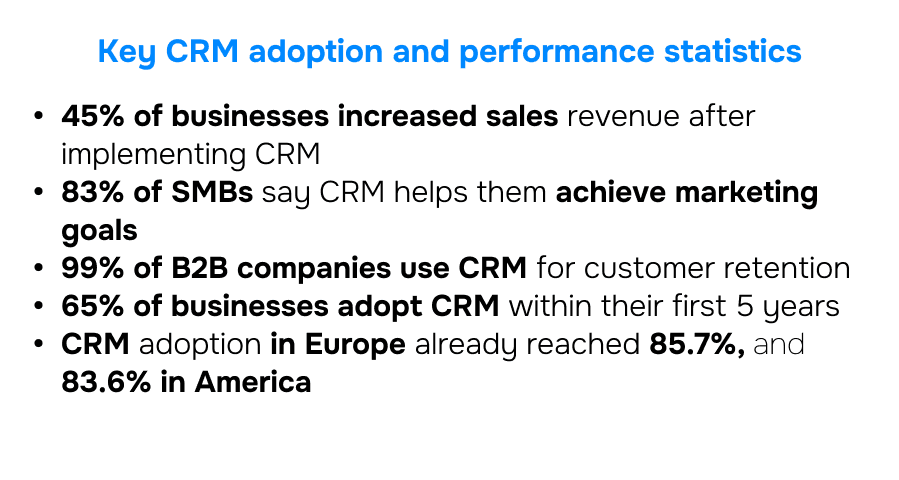
All these advantages are not theoretical. Recent industry research clearly shows why sales automation and CRM adoption have become a priority for eCommerce companies of all size:
- 45% of businesses increased sales revenue after implementing CRM
- 83% of SMBs say CRM helps them achieve marketing goals
- 99% of B2B companies use CRM for customer retention
- 65% of businesses adopt CRM within their first 5 years
- CRM adoption in Europe already reached 85.7%, and 83.6% in America
Comparison: Before and After CRM Implementation
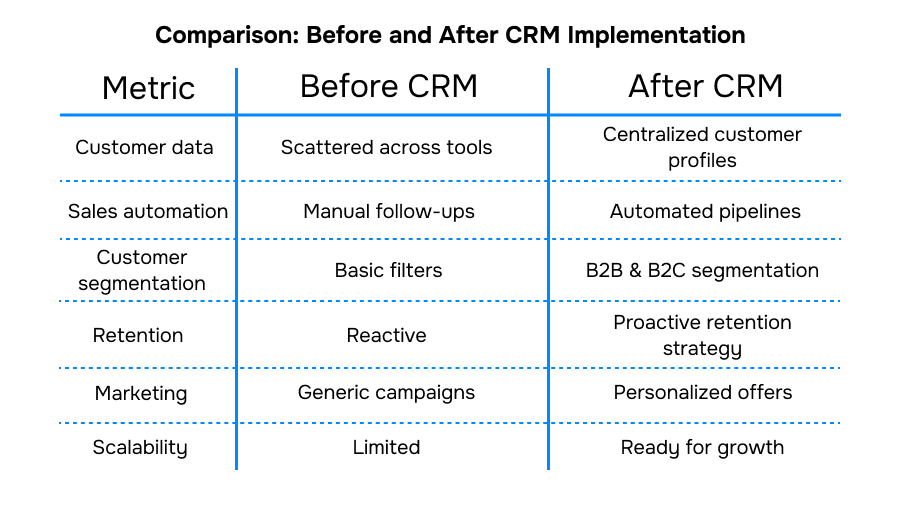
This transformation is exactly what we delivered in our custom CRM projects. Real example: Back-office CRM for a trade company - we automated inventory, documents, and client interactions inside a secure CRM, eliminating manual operations.
Let’s explore eCommerce CRM solutions that actually help businesses grow - starting with real systems we’ve built at Abyron
When companies start looking for the best CRM for eCommerce, they usually compare popular platforms first. Salesforce, HubSpot, Zoho, Odoo - the usual shortlist. But in practice, many businesses discover a deeper issue: their sales, marketing, and operational workflows don’t fully fit into ready-made CRM logic. That’s exactly where our experience comes in. Over the years, we’ve helped eCommerce companies move beyond generic setups - either by deeply customizing existing CRM platforms or by building tailored CRM systems from scratch. Let’s walk through the most effective CRM approaches for eCommerce in 2026, starting with real solutions we’ve delivered at Abyron.
1. Custom eCommerce CRM by Abyron - Built Around Real Business Processes
Before choosing a boxed CRM, many eCommerce companies face operational chaos behind the scenes. Orders live in one system, inventory in another, customer communication in emails, and reporting in spreadsheets. One of our clients came to us with exactly this challenge.
They needed a CRM that could unify sales, inventory, documents, and customer interactions - without forcing their team to adapt to rigid platform limitations. So we developed a custom eCommerce CRM tailored to their workflows.
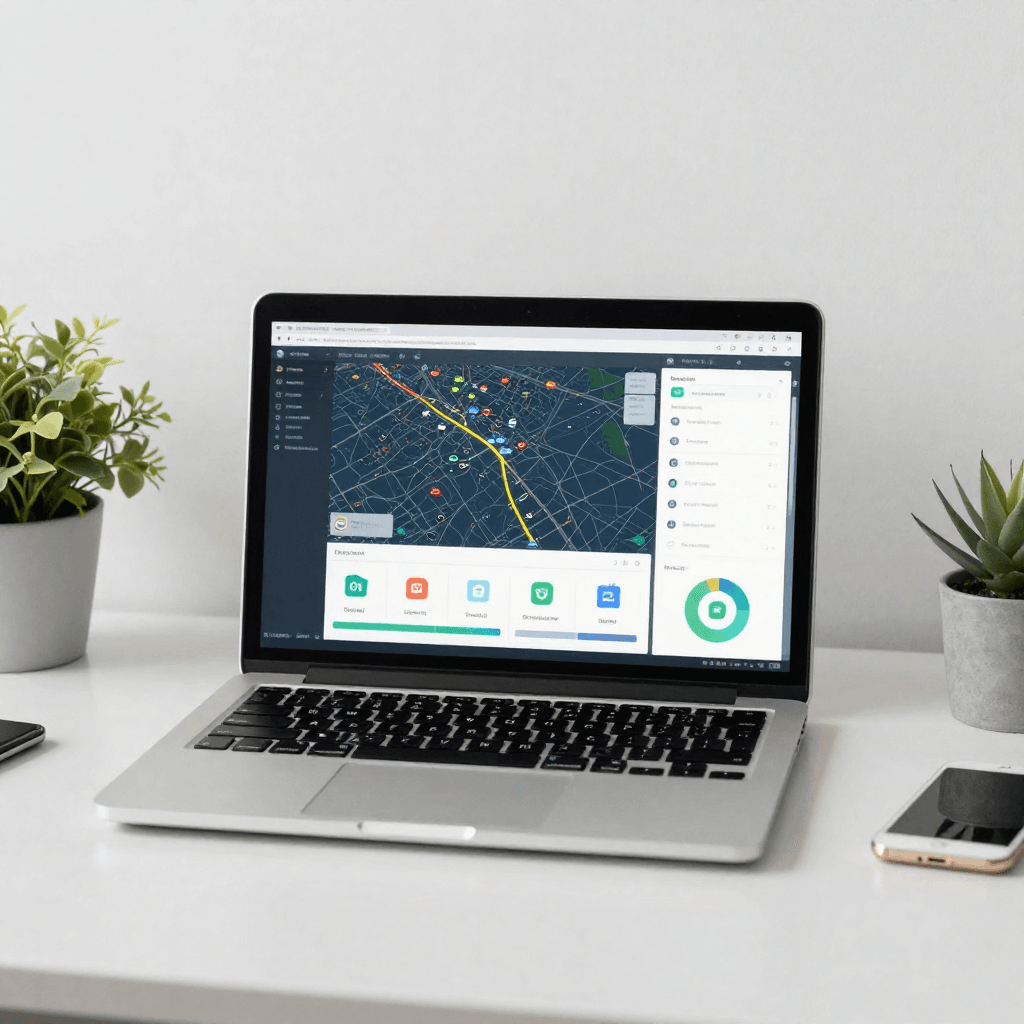
In one case, for a trade company, we built a secure back-office CRM that gave full control over inventory, documents, and client interactions Back-office CRM for a trade company
What these custom CRM solutions enabled:
- centralized customer and order data
- real-time inventory tracking
- automated document flows and approvals
- flexible customer segmentation for B2B and B2C
- secure role-based access for teams
- seamless integration with eCommerce platforms
After launch, clients reported smoother operations, faster order processing, and better visibility across departments. This approach clearly shows that when growth accelerates, a custom CRM can outperform any off-the-shelf solution.
2. Salesforce - Enterprise-Level CRM for Scalable eCommerce Operations
Salesforce remains one of the most powerful eCommerce CRM solutions on the market. Many still ask why Salesforce is the best CRM - and the answer lies in its scalability, automation depth, and ecosystem. Salesforce is often chosen by growing and enterprise eCommerce businesses that need:
- advanced sales automation
- complex workflow automation in CRM
- deep customer segmentation
- AI-powered personalization
- integration with ERP, marketing, and analytics tools
Salesforce shines when companies need to scale globally, manage multiple sales pipelines, and run highly personalized marketing campaigns. That said, implementation without experience often leads to unnecessary complexity and high costs.
3. HubSpot CRM - A Smart Choice for Growing eCommerce Teams
HubSpot is frequently considered the best CRM software for small business and fast-growing mid-size stores. Its strength lies in usability and quick adoption. For eCommerce teams, HubSpot offers:
- sales automation and pipeline visibility
- marketing automation tied to customer behavior
- Shopify and Magento integration
- clear reporting without heavy configuration
Many online stores choose HubSpot when they want to improve customer retention and launch personalized marketing campaign optimization without months of setup. However, as businesses scale, limitations in customization and automation depth often appear. In such cases, we help clients extend HubSpot with custom integrations or migrate to more flexible CRM architectures.
4. Odoo - Unified CRM + ERP for Operationally Complex eCommerce
Odoo works well for companies that want CRM tightly connected to inventory, accounting, and logistics. It’s a strong option for omnichannel eCommerce businesses managing both online and offline sales.
With Odoo, companies get:
- CRM and ERP in one ecosystem
- built-in eCommerce automation tools
- customer segmentation across sales channels
- flexible workflow automation
Odoo becomes especially effective when tailored correctly. We often customize Odoo for clients who want to scale without juggling multiple disconnected systems.
5. Zoho CRM - Cost-Effective eCommerce CRM Solutions
Zoho CRM is a solid option for budget-conscious businesses that still want automation and integration. It supports:
- sales automation and lead tracking
- basic customer segmentation
- Shopify integration
- multichannel communication Zoho works best for early-stage eCommerce companies focused on growth efficiency rather than deep customization.
How Abyron helps eCommerce businesses grow with CRM
At Abyron, we don’t sell “CRM licenses.” We design systems that support real business processes. Our team works with:
- custom CRM development
- CRM integration with Shopify and Magento
- sales and workflow automation
- CRM scaling via outstaffing or outsourcing
We also adapt platforms for international expansion, including US market requirements: Read the full article here
If you’re planning CRM implementation, migration, or scaling, the fastest way to avoid costly mistakes is to talk to experts who’ve already built these systems in production. Contact us through the form
We’ll help you choose, build, or customize the CRM that actually supports your eCommerce growth - not just today, but in 2026 and beyond.
Best CRM platforms for eCommerce in 2026: comparison overview
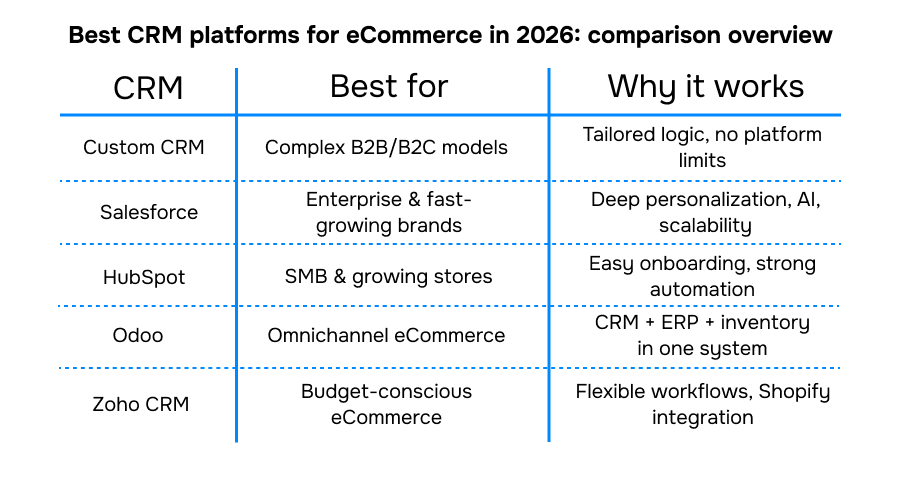
This is why many growing companies move toward custom CRM development or deep customization via outsourcing or outstaffing models. We often recommend one of two paths:
- Outsourcing when you need a full CRM solution delivered end-to-end
- Outstaffing when you want dedicated CRM developers integrated into your team
We explain the difference in detail here: Outsourcing vs Outstaffing: How to Choose the Right Model to Reduce Software Development Costs
And why outstaffing helps scale faster: 7 Reasons Outstaffing Is a Game-Changer for Startups/Scale-ups
AI-Powered CRM: How Artificial Intelligence Improves eCommerce Performance
Artificial intelligence has become a practical part of modern eCommerce CRM systems. AI helps businesses move faster, reduce manual work, and make better decisions based on real customer data - not assumptions.
In CRM platforms, AI is commonly used to:
- predict customer behavior and purchase intent
- automate lead scoring and sales prioritization
- optimize personalized marketing campaigns
- forecast demand and identify churn risks
- power chatbots and smart customer support
These capabilities directly support sales automation, which remains the most requested CRM feature. Buyers consistently prioritize workflow automation, lead management, and pipeline visibility - areas where AI delivers the strongest impact.
We apply the same AI-first approach in real business systems. One example is our work on an AI-powered ERP solution for logistics, where machine learning improved forecasting accuracy, reduced operational errors, and increased overall efficiency. The same principles apply to eCommerce CRM platforms that rely on data-driven automation and predictive analytics.
Read more about this project here
For growing eCommerce businesses, AI-enhanced CRM is no longer optional. It becomes a foundation for scalable personalization, smarter sales processes, and long-term customer retention.
Frequently Asked Questions
Q1: What is the best CRM software for small business eCommerce?
A1: For small stores, HubSpot and Zoho often work well. Once workflows grow more complex, custom CRM or Odoo becomes more effective.
Q2: Why Salesforce is the best CRM for eCommerce?
A2: Salesforce excels at sales automation, customer segmentation, and AI-driven personalization, especially for large or fast-growing stores.
Q3: What is sales automation in eCommerce?
A3: Sales automation means using CRM workflows to handle leads, follow-ups, abandoned carts, and pipeline stages automatically.
Q4: Why customer segmentation is important?
A4: Segmentation enables personalized communication, better retention, and higher lifetime value, especially in B2B customer segmentation.
Q5: How does CRM improve customer retention?
A5: CRM centralizes customer history and enables proactive retention strategies through personalized messaging and lifecycle automation.



CONTACT US